Why Compare JSON Files? Understanding the Need for a JSON Compare Tool
In the world of web development, APIs, and json data exchange, JSON (JavaScript Object Notation) has become the de facto standard. Developers, testers, and data analysts often find themselves needing to compare json files to identify subtle differences. This is crucial for:
- Debugging API Responses: When expected output differs from actual json data.
- Environment Management: Comparing json files across development, staging, and production.
- Data Integrity: Verifying online json structures after migrations.
- Version Control: Tracking a json diff over time to see schema changes.
Manually sifting through two json structures to pinpoint discrepancies is tedious. An efficient json file compare online utility is no longer a luxury—it is an essential compare tool.
What is a JSON Compare Online Utility?
A json compare tool is a free online web-based application designed to highlight the differences between two json inputs. These tools parse your data, use a json formatter to improve readability, and perform a structural diff.
Instead of manually checking every bracket, an online json comparator visually indicates added, deleted, or modified elements. It acts as both a json formatter and a compare engine, ensuring your json format is clean before the diff begins.
How to Compare JSON and Format Data: A Step-by-Step Guide
Using a free online json compare service is straightforward. Follow these steps to compare json files like a pro:
Step 1: Choose Your JSON File Compare Online Tool
Search for a reliable json compare online site. Look for one that offers a clear diff view, a built-in formatter, and a secure way to format, save, and share results.
Step 2: Input Your JSON Data
Most tools provide two input panes. You can:
- Paste your first json file content into the “Source” pane.
- Paste your second json file into the “Target” pane.
- Upload the files directly if the compare tool supports it.
Step 3: Use the JSON Formatter
Before you compare, ensure your json format is valid. A built-in json formatter will “pretty print” your code, making the diff online much easier to read.
Step 4: Initiate the JSON Diff
Click the compare or diff button. The online utility will process the json data and display the results in a color-coded diff view.
Analyzing the Diff Online: What the Colors Mean
When you compare json, the diff view usually follows a standard color scheme:
- Green: Indicates additions in the second json file.
- Red: Indicates deletions present only in the first json file.
- Yellow/Orange: Indicates modified values within the json data.
Many tools also allow you to save the comparison report or share the json diff results with your team via a secure link.
Key Features to Look for in a JSON Compare Tool
When searching for the best json file compare online utility, prioritize these features:
- Side-by-Side Diff: The most intuitive way to compare json files.
- Syntax Highlighting: Makes the json format easier to navigate.
- Ignore Order: Useful if the order of keys in your json files doesn’t matter.
- Cloud Save: The ability to save and share your diff reports for later.
- YAML/XML Support: Some tools can compare multiple file types.
Conclusion: Master Your JSON Data with an Online Compare Tool
An effective json file compare online utility is an asset for any developer. It streamlines identifying discrepancies, improves json format consistency, and boosts productivity. By utilizing a free online json compare tool, you can ensure your json files are accurate and your json data is intact. Stop wasting time with manual checks—format, compare, and share your json structures with confidence today!
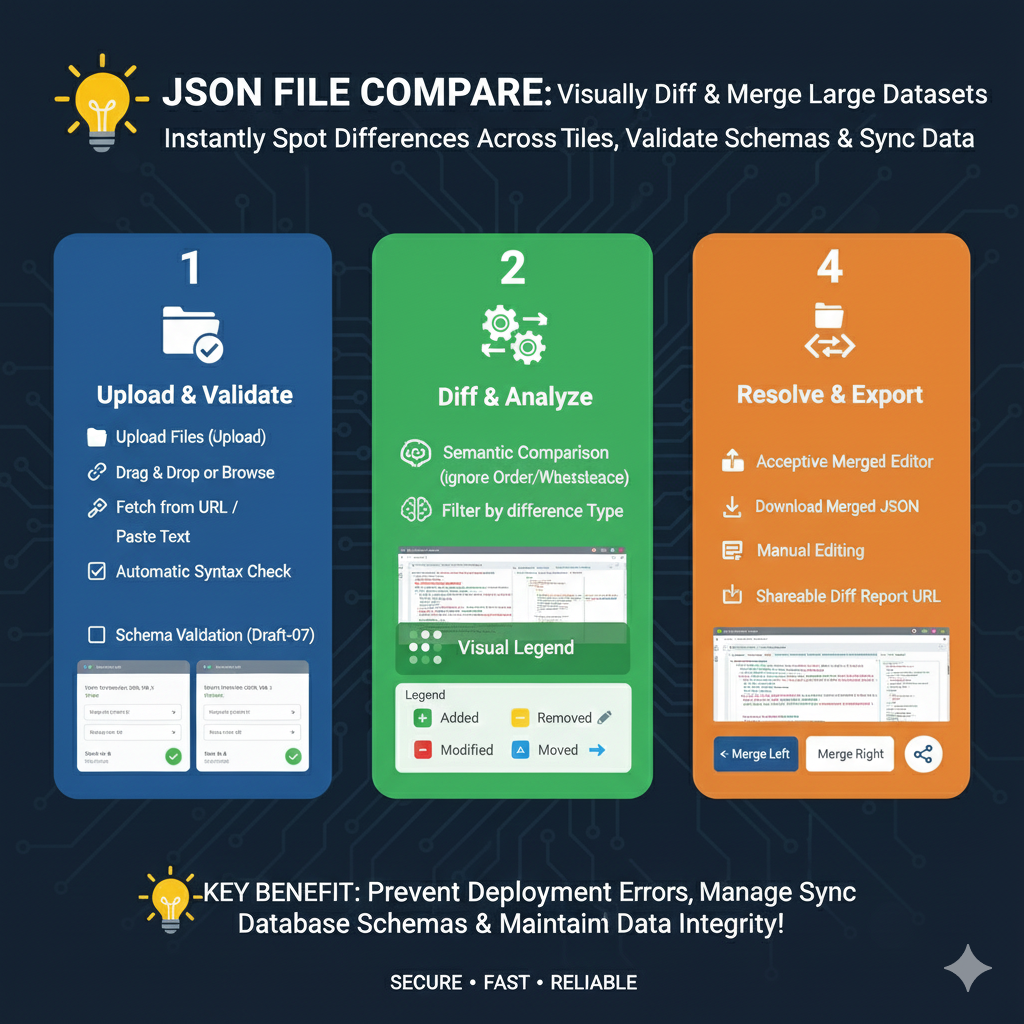
Optimized JSON Comparison Workflow
The process is structured into three distinct phases to ensure data integrity and reduce manual error during the comparison of large datasets:
1. Upload & Validate (Blue)
This phase focuses on the secure and accurate ingestion of data:
- Multi-Method Ingestion: Users can Upload Files, use Drag & Drop, Fetch from URL, or simply Paste Text.
- Integrity Checks: The tool performs an Automatic Syntax Check and supports Schema Validation (Draft-07) to ensure files are structurally sound before analysis begins.
2. Diff & Analyze (Green)
This section details the intelligent comparison engine used to visualize discrepancies:
- Semantic Comparison: The engine is smart enough to ignore key order and whitespace, focusing only on meaningful data changes.
- Visual Legend: Differences are categorized with a clear color-coded system:
- Added (+): New elements found in the target file.
- Removed (-): Data missing from the target file.
- Modified (Δ): Values that have changed between versions.
- Moved (→): Elements that exist in both but have changed positions.
- Targeted Filtering: Users can Filter by difference Type to focus on specific changes rather than scanning the entire file.
3. Resolve & Export (Orange)
The final stage provides tools for reconciling data and sharing results:
- Interactive Editing: Features an Adaptive Merged Editor and supports Manual Editing to resolve conflicts on the fly.
- Direct Export: Users can Download Merged JSON directly to their local machine.
- Collaboration: Provides a Shareable Diff Report URL to allow team members to review the comparison results.
learn for more knowledge
Mykeywordrank-> small seo tool for keyword rank checking and local rank checker – keyword rank checker
json web token-> python jwt: How to Securely Implement jwt in python – json web token
Json Parser->Jackson JSON Parser: A Comprehensive Guide to Parse JSON for Java Developers – json parse
Fake Json –>How to Generate and Use Dummy JSON Data for Development and Testing – fake api
Leave a Reply